





For credit unions, staying current with digital banking platforms is no longer optional; it is a foundational requirement for security, compliance, and member satisfaction. Yet many institutions still approach upgrades reactively, introducing unnecessary risk and operational strain.
This article outlines a structured, risk-aware approach to managing regular upgrades. Key takeaways:
- Regular upgrades reduce security exposure and ensure ongoing regulatory alignment
- Delayed upgrades increase operational risk and technical debt
- A disciplined approach, combining governance, testing, and phased rollouts, minimizes disruption
- Strong vendor alignment and automation are critical enablers
- Upgrade maturity is a strategic capability, not just an IT function
The Cost of Standing Still
Digital banking has become the primary channel for member engagement. Expectations are shaped not just by other financial institutions, but by leading digital experiences across industries, including real-time interactions, intuitive interfaces, and continuous improvement.
At the same time, credit unions operate in a highly regulated environment with heightened expectations around security, resilience, and auditability. This creates a natural tension: the need to evolve quickly while maintaining operational stability.
Deferring platform upgrades may feel like risk avoidance. In reality, it often compounds risk, introducing security vulnerabilities, limiting vendor support, and increasing the complexity of future changes.
Leading credit unions are shifting their mindset: upgrades are no longer treated as disruptive events, but as part of a continuous, controlled lifecycle.
Upgrade Cadence: Quarterly vs. Infrequent Upgrades
One of the most consequential decisions credit unions make is not whether to upgrade, but how often.
At a high level, institutions tend to fall into two patterns:
Infrequent Upgrades (Every 1–3 Years)
This approach is often driven by perceived risk reduction and resource constraints. However, it introduces significant challenges:
- Larger change sets: multiple releases bundled into a single upgrade increase complexity
- Higher testing burden: regression scope grows exponentially
- Greater operational risk: more moving parts mean higher likelihood of failure
- Longer recovery time: troubleshooting becomes more difficult due to accumulated changes
- Vendor pressure: forced upgrades due to end-of-life timelines
In practice, infrequent upgrades tend to create the high risk they aim to avoid.
Regular Cadence (e.g., Quarterly or Incremental)
A more modern approach is to align with a predictable, frequent upgrade cycle (typically every 3–6 months), depending on vendor release patterns.
Key advantages include:
- Smaller, manageable changes: each release introduces limited, well-understood updates
- Reduced testing scope: focused regression testing improves efficiency and coverage
- Lower failure impact: issues are isolated and easier to diagnose
- Continuous alignment with vendor roadmap: avoids last-minute, forced upgrades
- Improved team readiness: operational processes become routine rather than exceptional
- Incremental tech debt reduction: Instead of allowing issues to accumulate over years, regular upgrades create a predictable window to address technical debt incrementally.
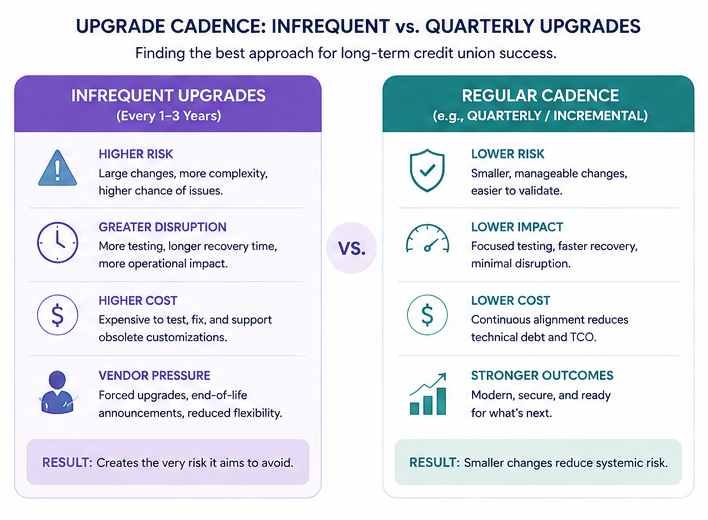
This model mirrors broader software engineering best practices: smaller, incremental changes reduce systemic risk.
What “Regular Upgrades” Really Mean
Not all upgrades are equal, and clarity here is essential.
Regular upgrades typically include:
- Minor releases: bug fixes, small enhancements, security patches
- Major releases: new features, architectural changes, UI updates
- Platform dependencies: middleware, APIs, mobile app frameworks
These changes impact multiple layers:
- Digital banking interfaces (web and mobile)
- Integration layers and APIs
- Core banking connectivity
- Third-party services (payments, authentication, analytics)
Mature organizations evolve from:
- Reactive upgrades (driven by urgency or end-of-life deadlines)
to - Planned cycles (scheduled, predictable updates)
and ultimately to - Continuous upgrade readiness (incremental, low-risk changes embedded in operations)
Customization vs. Out-of-the-Box (OOTB): Finding the Right Balance
Customization plays a major role in the cost, complexity, and risk of digital banking upgrades. While custom features can support unique member experiences and workflows, excessive customization often creates long-term maintenance challenges.
Modern digital banking platforms now offer strong out-of-the-box (OOTB) functionality, making it easier for credit unions to reduce complexity while still delivering value.
Why Out-of-the-Box (OOTB) Capabilities Matter
Using standard platform functionality provides several benefits:
- Faster upgrades
- Lower testing effort
- Reduced reliance on specialized developers
- Better vendor support alignment
- Easier adoption of future enhancements
Because OOTB features are typically the most tested within a platform ecosystem, they generally lead to fewer upgrade issues and greater operational sustainability.
The Hidden Cost of Heavy Customization
Customizations require ongoing validation and maintenance during every upgrade cycle. Common examples include:
- Custom UI components
- Modified authentication flows
- Proprietary integrations
- Custom reporting tools
- Unsupported vendor extensions
Over time, these can lead to:
- Increased upgrade complexity
- Higher regression testing demands
- Slower adoption of new features
- Greater vendor dependency risk
- Accumulating technical debt
Customization Should Be Strategic
Customization is still important when it supports:
- Competitive differentiation
- Unique member service strategies
- Specialized operational requirements
- Enterprise integrations
However, mature organizations evaluate customization carefully by asking:
- Does this create meaningful business value?
- Can configuration solve the requirement instead of custom code?
- What is the long-term maintenance impact?
- How will this affect future upgrades?
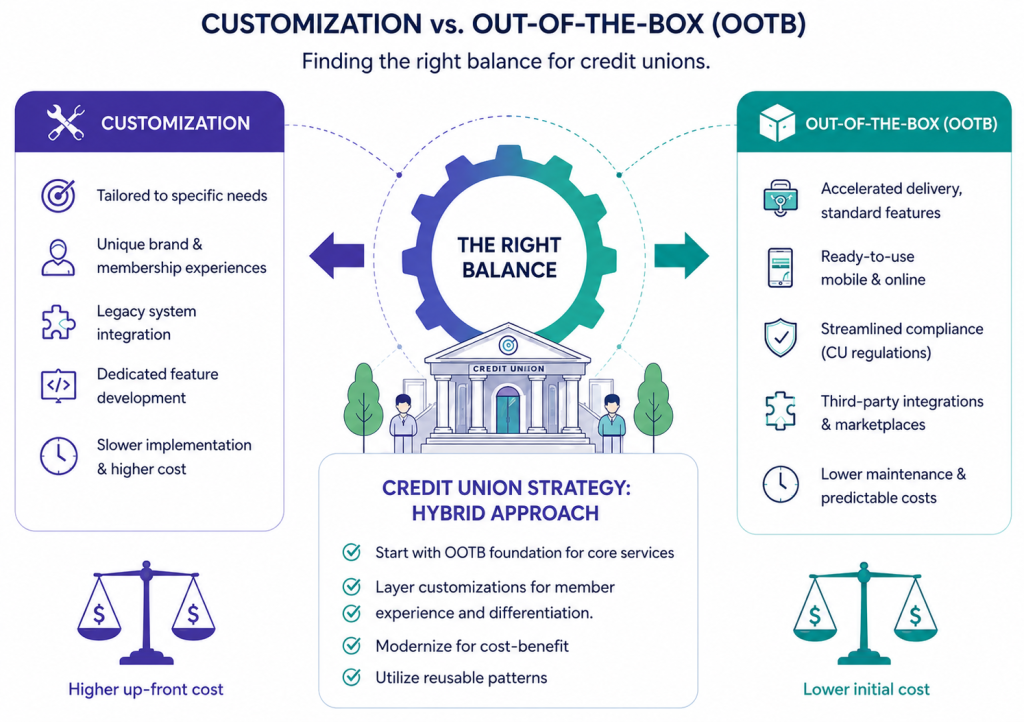
This shifts customization from a tactical decision to a strategic architectural choice.
A Sustainable Approach
Leading credit unions increasingly follow a “configure before customize” approach:
- Use OOTB capabilities whenever practical
- Extend through supported APIs and configuration layers
- Reserve deep customization for high-value differentiators
This helps reduce upgrade friction while maintaining flexibility where it matters most.
Breaking vs. Non-Breaking Upgrades
Not all upgrades carry the same level of risk. A key distinction for credit unions is whether a release introduces breaking or non-breaking changes.
Understanding this difference is essential for planning, testing, and stakeholder communication.
Non-Breaking Upgrades
Non-breaking (backward-compatible) changes are designed to work without disrupting existing functionality.
Typical examples include:
- Security patches
- Performance improvements
- Additive API enhancements
- Minor UI updates that do not alter user flows
These upgrades:
- Require standard regression testing
- Can often follow a streamlined deployment path
- Are well-suited for more frequent release cycles
For mature teams, non-breaking upgrades should become routine, low-risk operational activities.
Breaking Upgrades
Breaking changes introduce modifications that can disrupt existing integrations, workflows, or user experiences.
Common examples:
- API contract changes (e.g., modified request/response structures)
- Authentication or security model updates
- Significant UI/UX redesigns
- Deprecation or removal of existing features
These upgrades require:
- Impact analysis across systems and vendors
- Coordination with internal and external stakeholders
- Expanded testing scope (including integration and user acceptance testing)
- Detailed rollout and rollback planning
In a credit union context, breaking changes often have downstream effects on core banking integrations, payment systems, and member-facing channels.
Why Credit Unions Struggle with Upgrades
Despite clear benefits, many credit unions face persistent challenges:
Operational Risk Sensitivity
Even minor disruptions can impact member trust. This drives a tendency to delay change unless absolutely necessary.
Tight Core Integration
Digital banking platforms are often deeply coupled with core systems, making upgrades complex and high-stakes.
Limited Engineering Capacity
Many institutions rely on lean internal teams, limiting their ability to test and implement changes efficiently.
Vendor Dependency
Release cycles, documentation quality, and support responsiveness vary significantly across vendors.
Change Management Constraints
Any visible change to the member experience requires careful communication and internal readiness.
These factors are real, but manageable with the right structure.
The Hidden Risks of Delaying Upgrades
Postponing upgrades introduces cumulative risk across several dimensions:
- Security Exposure: unpatched vulnerabilities in outdated components
- Compliance Gaps: misalignment with evolving regulatory expectations
- Support Limitations: vendors phasing out older versions
- Integration Fragility: increasing incompatibility with modern services
- Technical Debt Accumulation: larger, riskier upgrades in the future
In practice, the cost of inaction often exceeds the perceived risk of change.
Best Practices for a Sustainable Upgrade Strategy
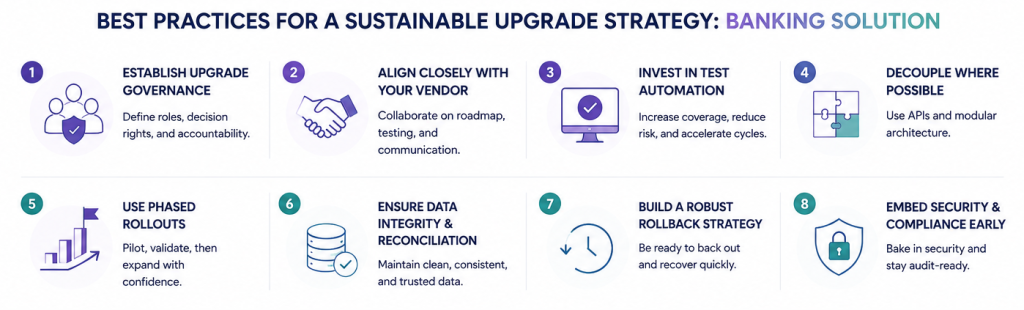
Establish Upgrade Governance
Define clear ownership and decision-making structures:
- Cross-functional involvement (IT, Digital, Risk, Vendor Management)
- Regular release review cadence
- Explicit go/no-go criteria
Governance transforms upgrades from ad hoc activities into controlled processes.
Align Closely with Your Vendor
Strong vendor alignment reduces surprises:
- Maintain proactive communication channels
- Participate in early access or sandbox programs
- Track release notes and deprecation timelines
Early visibility enables better planning and risk mitigation.
Invest in Test Automation
Testing is the single most important risk control in upgrade execution.
Focus areas:
- Regression testing for critical member journeys (login, transfers, payments)
- API contract validation
- Synthetic transaction monitoring
- Production-like staging environments
Automation reduces both effort and human error while increasing confidence.
Decouple Where Possible
Architectural flexibility reduces upgrade complexity:
- Adopt API-first design principles
- Introduce middleware layers to isolate dependencies
- Avoid direct coupling between digital channels and core systems
Decoupling allows components to evolve independently.
Use Phased Rollouts
Avoid “big bang” releases wherever possible:
- Start with internal users (employees)
- Expand to pilot member groups
- Gradually scale to full deployment
Techniques such as feature flags and canary releases significantly reduce risk.
Ensure Data Integrity and Reconciliation
Accuracy is non-negotiable in financial systems.
Best practices:
- Pre- and post-upgrade data validation
- Transaction consistency checks
- Comprehensive audit logging
Even minor discrepancies can have outsized operational impact.
Build a Robust Rollback Strategy
Every upgrade plan should include a clear exit path:
- Verified backup and recovery procedures
- Defined rollback triggers
- Time-bound decision windows during release
Preparedness is what makes controlled risk-taking possible.
Embed Security and Compliance Early
Security should not be a post-upgrade checkpoint; it must be integrated throughout:
- Security testing within the development lifecycle
- Documentation aligned with audit requirements
- Traceability for all changes
This approach reduces friction during regulatory reviews.
Managing Member Impact
Upgrades are not just technical events; they are member-facing changes.
Communication Strategy
- Provide advance notice of meaningful changes
- Clearly articulate benefits, not just changes
Internal Readiness
- Train call center and branch staff
- Prepare support teams for expected inquiries
Post-Release Monitoring
- Track support tickets and feedback trends
- Monitor user behavior and adoption metrics
Effective change management preserves trust during transition.
Metrics That Matter
To improve, you need visibility. Key metrics include:
- Upgrade lead time (planning to deployment)
- Change failure rate
- Post-release incident volume
- System performance and availability
- Member satisfaction indicators (CSAT, app ratings)
These metrics help quantify both risk and progress.
A Typical Maturity Journey
Most credit unions evolve through a recognizable progression:
Initial State
- Infrequent upgrades
- High operational risk
- Limited testing
Transitional State
- Defined governance
- Improved vendor coordination
- Partial automation
Mature State
- Predictable upgrade cycles
- High test coverage
- Low-risk, incremental releases
The goal is not perfection; it is consistency and control.
From Maintenance to Strategic Capability
Regular platform upgrades are often viewed as operational overhead. In reality, they are a strategic enabler.
A disciplined upgrade approach allows credit unions to:
- Respond faster to member expectations
- Integrate new services more efficiently
- Maintain strong security and compliance posture
In a competitive and regulated environment, the ability to evolve safely and continuously is a defining capability.
Conclusion
The question is no longer whether to upgrade regularly, but how to do so without introducing unnecessary risk.
Credit unions that invest in governance, automation, and structured rollout strategies will not only reduce operational friction but also position themselves to innovate with confidence.
The path forward is clear: treat upgrades not as disruptions, but as a core component of modern digital banking operations.
