





"The biggest AI risk for credit unions is not moving too slowly — it’s investing without readiness.”
Adrian Moise, CEO & Founder of Aequilibrium
(Part of AEQ’s Thought Leadership Series on Digital Transformation for Credit Unions)
Introduction
Most credit unions don’t have an AI problem.
They have an AI overwhelm problem.
Leaders everywhere are inundated with new ideas, tools, or pressure to act. Conference speakers forewarn of the pending AI takeover. But when everything feels urgent, nothing gets done. Execution stalls. Priorities blur. And AI remains stuck in experimentation rather than delivering measurable impact.
So the real question leaders need to ask isn’t:
“Should we be using AI?”
But rather:
“What actually matters, and where do we start?”
First, Face Reality: AI Is Already in Your Organization
AI is already in use across your organization, whether it’s governed or not.
Teams are using it, some quietly or individually. A few tools may have been purchased. The odd pilot has started in order to experiment with:
- Drafting and refining communications faster
- Summarizing meetings and documents
- Using AI-assisted tools for analysis and decision support
This is happening informally, often outside of structured oversight.
This “shadow AI” is not the problem. It’s a signal.
The good news is that it provides valuable clues:
- Where operational friction exists
- Where teams are seeking efficiency
- Where early, organic use cases are already emerging
So the real risk is not AI adoption.
The risk is uncoordinated adoption without governance, data discipline, or architectural alignment.
AI Is Not a Tool Decision. It’s an Operating Model Decision.
A common mistake is approaching AI the same way organizations approach software:
- Evaluate vendors
- Run pilots
- Integrate into existing workflows
That approach produces incremental improvements, but rarely meaningful transformations.
Employing AI as an effective tool doesn’t just improve tasks. It changes how work is structured, how decisions are made, and how systems interact.
The more important question every leader must ask: “If AI is embedded into how we work, what needs to change across workflows, systems, and decision points?”
This is why AI readiness is not an isolated initiative. It’s an operating model shift.
Most CUs Are Less AI-Ready Than They Think
Across both Canadian and U.S. credit unions, we consistently see the same pattern:
- AI experimentation is happening, but it’s not coordinated
- Leadership understands the potential, but lacks a clear execution path
- Technology teams are evaluating options, but outcomes aren’t scaling
This creates a disconnect between activity and impact.
Closing that gap does not require a large, multi-year strategy upfront.
It requires focused execution, grounded in governance, data, and a clear use-case definition.
The 3 Areas That Will Determine AI Success in Your CU
Before building out broader roadmaps, three foundational moves consistently determine whether AI efforts progress or stall:
1. Establish AI Governance
AI introduces new considerations around data usage, decision accountability, and risk exposure.
At a minimum, the CU executive team must set direction and definitions for:
- Approved tools and procurement pathways
- Data classification and usage boundaries
- Human-in-the-loop requirements for decision-making
- Oversight structures aligned to executive and board governance
The goal is not to restrict innovation or stop champions of change, but rather to create the best conditions for safe, scalable adoption to come.
2. Conduct a Focused Data Audit
AI performance is directly tied to data quality, structure, and accessibility.
A targeted data audit should clarify:
- Where member and operational data reside
- Data consistency and normalization levels
- Integration readiness across core systems, CRMs, and digital platforms
In most cases, the challenge is not a lack of data; it’s fragmentation and usability.
Understanding what is realistically usable today (and what data should be in the queue for cleanup) is critical before expanding AI initiatives.
3. Define One Priority Use Case
- Momentum is often lost when organizations attempt to pursue multiple use cases simultaneously.
Instead, define one use case:
- Clearly scoped
- Measurable
- Aligned to either operational efficiency or member experience
Two practical starting categories:
- Efficiency-focused (lower complexity):
- Member service chat automation
- Internal knowledge retrieval
- Meeting and documentation workflows
2. Experience-focused (higher impact):
- Personalized member engagement
- AI-assisted financial insights
- Proactive service models
With credit unions holding deep values related to human-centric service and community connection, the bigger AI wins are often those that free up your frontline staff to engage more deeply with members.
The objective is not breadth. It is a validated impact. Decide on the positive impact that matters, and how you want to measure that.
Once these priorities are clear, execution becomes straightforward.
What To Do Next - AEQ-5: Five Steps to AI Readiness for Credit Unions
At AEQ, we took our five-step approach to digital transformation (see AEQ-5 Proven Migration Process) and applied the same framework to help our credit union clients prepare for AI integrations.
The following is a summary of our guide called AEQ-5: Five Steps to AI Readiness for Credit Unions. This is a structured five-step approach to move from AI experimentation to scalable outcomes.
1. Establish AI Governance
Define how AI is used across the organization:
- Tooling standards and procurement controls
- Data usage and privacy boundaries
- Clear accountability for AI-supported decisions
2. Conduct a Targeted Data Audit
Assess what data can support AI initiatives today:
- Data sources and system ownership
- Quality, structure, and accessibility
- Integration constraints across platforms
3. Define One Priority Use Case
Select a focused starting point:
- Clear business objective
- Defined success metrics
- Alignment to operational or member impact
4. Test in a Controlled Environment
Validate safely before scaling:
- Sandbox or contained pilot
- Cross-functional involvement (business + technology)
- Early measurement of outcomes
5. Scale What Works (Deliberately)
Expand based on evidence – not assumption:
- Standardize successful workflows
- Assign ownership and governance
- Build repeatable patterns for future use cases
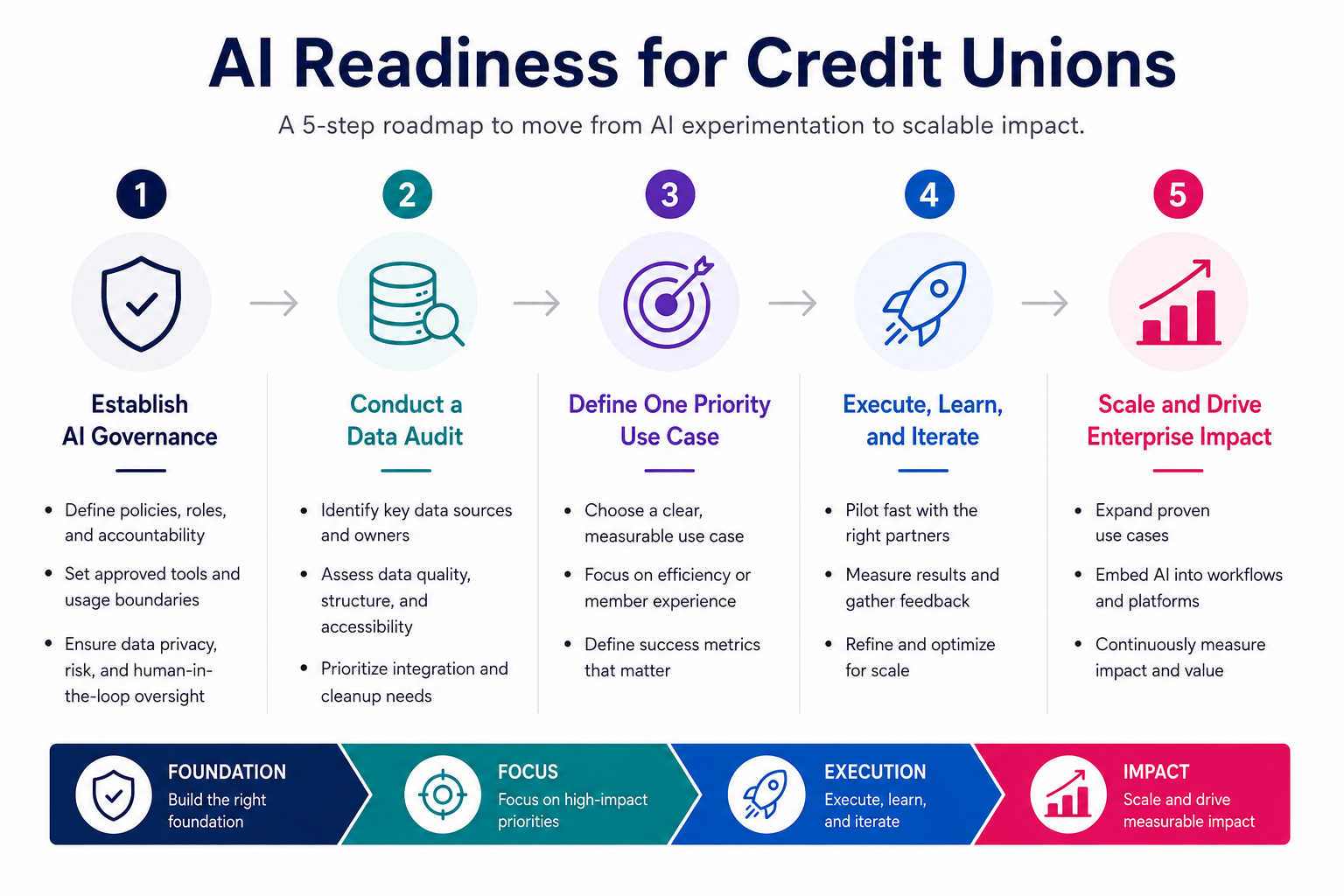
This five-step approach is intentionally simple. Not because AI is simple, but because execution needs to be.
Where Most Organizations Go Off Track
The most common challenges are consistent:
- Starting with tools instead of architecture and priorities
- Treating AI as an IT initiative instead of a business capability
- Underestimating data readiness requirements
- Focusing on isolated efficiencies rather than end-to-end workflows
AI does not require perfect conditions to begin. But it does require intentional structure.
What This Means for Credit Union Leaders
AI is not a discrete technology investment.
It is a shift in how work is executed, decisions are supported, and member value is created and delivered.
Credit unions that move forward with clarity will:
- Improve operational efficiency
- Deliver more relevant and personalized member experiences
- Build internal capability to adopt AI responsibly and at scale
Those who delay or move without structure will continue to experiment without realizing meaningful return.
Final Thought
The credit unions that succeed with AI over the next 3 years will not necessarily be the ones experimenting the fastest - they will be the ones building the right organizational foundations today.
AI readiness is not about being advanced. It’s about being deliberate.
The organizations that succeed will not be the ones doing the most with AI. They will be the ones doing the right things first and building from there.
For a deeper, more technical view on how AI is evolving toward agentic systems—and what that means for financial institutions, see: “Scaling the Credit Union Value by Charting a Course Toward Agentic AI” by Baris Tuncertan, Head of Technology at Aequilibrium.
